By Jeff Maisey
Many independent craft beer makers across Virginia have recently answered the call to brew a commemorative release to promote the Commonwealth’s connection to America’s 250 anniversary and the vital role alehouses played in fermenting discussions and ideas of liberty.
The history of brewing beer in the Commonwealth — the land of Washington, Jefferson and other notable Founding Fathers — came to light eight years ago in a well-researched book from writer Lee Graves titled “Virginia Beer: A Guide from Colonial Days to Craft’s Golden Age” (University of Virginia Press).
Long before the final wording of the Declaration of Independence was approved by Congress on July 4, 1776 and then signed on August 2 of that year, beer was central to the lives of English colonists.
“Virginia claims a unique place in the country’s beer history,” Graves said in a 2018 interview with Virginia Craft Beer Magazine. “The first English settlers brought beer with them in 1607, and brewing has been a constant ever since. Virginia can trace its hop industry to the early 1600s and was the top hops producing state in the South up to the Civil War.”
The soft-back book reminds us of where and why it all began. Graves delved into the unexpected role of women and slaves in the brewing of beer.
“I’m fascinated by the roles of women and slaves in early Virginia brewing history,” Graves said. “Women supervised brewing beer on plantations and improvised with numerous ingredients, everything from persimmons to corn stalks. Slaves grew hops in their own gardens and sold them to plantation owners and brewers for a profit—this occurred at Monticello, Mount Vernon, in Williamsburg, and elsewhere. Plus I have immense admiration for Peter Hemings, Thomas Jefferson’s slave who was trained by a professional brewer at Monticello.”
According to Colonialbrewer.com, “In Colonial America, beer was an absolute necessity rather than a luxury. It served as a safe, reliable source of hydration because the brewing process boiled and sanitized water, protecting colonists from deadly water-borne illnesses. It was also a cornerstone of social, political, and economic life.”
Much like the pubs back in the Olde World, establishments serving beer were gathering places where patrons discussed the issues of their day. Taverns such as Raleigh Tavern, Chowning’s, and Shields in Colonial Williamsburg were essential to the birth of democracy in America.
So, too, were King’s Arms Tavern (appealed to politicians and genteel colonists) and Christiana Campbell’s Tavern (said to be the favorite seafood establishment of George Washington when in Williamsburg).
Northamericanbrewers.org states, “Taverns and brewhouses were central to community life, serving as the primary venues for consuming beer. These establishments acted as vital hubs for sharing news and debating ideas. Groups like the Sons of Liberty famously used these spaces to organize and plant the seeds of the American Revolution.”
The most famous member of the Sons of Liberty from Virginia was Patrick Henry (“Give me liberty or give me death), but also includes Richard Henry Lee, Thomas Ludwell Lee, and Francis Lightfoot Lee of Westmoreland County on Virginia’s Northern Neck.
In fact, the Northern Neck was a hotbed of revolutionary discussion. Taverns in this region, according to a Colonial Williamsburg Research Report, acted “as inns, dining rooms, and clearinghouses for political ideas” and “served travelers, merchants, and planters.”
The research report also noted, “Taverns were heavily utilized as political test beds where the upper-class and revolutionaries gathered to discuss current events. Laws dictated that proprietors provide these spaces.”
One such tavern still stands today: Rice’s Hotel/Hughlett’s Tavern in Heathsville.
During the Revolutionary era in Virginia, patrons were primarily served porters, brown ales, strong ales, and what was known as small beers, a low alcohol daily consumed alternative to water.
Brewers used the common ingredients corn, spruce tips (for flavor/aroma), and molasses.
In fact, molasses was an important part of George Washington’s homebrew recipe for is said to be rich-flavored porter — his favorite style.
Like General/President Washington, other Founding Fathers are known to have beer style preferences.
John Adams was also a porter man, taking a liking to those of Philadelphia brewer Robert Hare.
Hare is credited with brewing the first porter in the New World. As president, George Washington had Hare’s delivered to the White House.
Thomas Jefferson enjoyed strong ales and had yeast strains imported to be used for beer making at Monticello.
It is said Benjamin Franklin sipped spruce ales with his dinner, but preferred wine.
A famous quote about beer attributed to Franklin was never actually spoken by him: “Beer is proof that God loves us and wants us to be happy.”
Bringing these beers of the American Revolution forward, Frank Clark of Colonial Williamsburg and worked with award-winning brewery Alewerks to produce a 17th-century English-style brown ale. The liquid’s recipe was based on historical records of that time.
The 5% ABV mahogany hued brew is sold at various Colonial Williamsburg taverns and retailers located at Merchants Square.
Alewerks also produces Dear Old Mum for Colonial Williamsburg. The spiced ale is unique and provides what is said to be an authentic taste of Williamsburg in the 1700s.
Alewerks continues to expand its relationship with the historic district.
“Late last year we also launched a 250th collaboration with them (Colonial Williamsburg) called Independence Ale, an approachable honey brown ale in a limited edition bottle,” said Michael Claar, Alewerks’ operations director. “It is still available for purchase at our Taprooms and Colonial Williamsburg retail stores.”
“We have also teamed up with Visit Williamsburg for another 250-themed beer called Pomp & Circumstance Social IPA,” Claar added. “Pomp & Circumstance has been so popular that it’s going into a second production run.”
Getting into the Spirit of 1776 in 2026 is contagious — spreading like the windy flames of revolution.
The breweries along Nelson County’s Route 151 — Blue Mountain Brewery, Blue Mountain Barrel House Brewery, Outback Brewery, Three Notch’d Brewery, and WildManDan Brewery — collaborated on Liberty Hollow Ale.
Martha Hayman, Blue Mountain’s director of marketing, described it this way: “Brewed from a recipe created for the National Brewers Association in 2006 to honor Benjamin Franklin’s 300th birthday, this American Dark Ale blends history with bold flavor. A hearty portion of corn lends a smooth body and subtle sweetness, while blackstrap molasses adds rich notes of dark caramel and bittersweet cocoa. Balanced and full-flavored, it’s a colonial-inspired ale with a distinctly American character.”
A promotional poster for Liberty Hollow features a revolutionary, military-clad horseman hoisting a wooden barrel over his head with the Blue Ridge Mountains in the background.
The St. George Brewing Company has brewed a trio of products representing the Historic Triangle. The London Porter celebrates Jamestown; An English IPA represents Williamsburg, and the Nut Brown Ale serves as Yorktown (with a label image of General George Washington and Lord Cornwallis). Nut Brown Ale, London Porter and English IPA. These are in 6-packs of 12oz cans, with Colonial-inspired artwork.
Lost Barrel Brewing (Middleburg) has unveiled Revolution Ale, which they describe as “Honoring the hearty ales of our nation’s founding era. This golden Revolutionary Ale blends malted wheat, corn, and molasses for creamy body and gentle sweetness, finished with delicate noble hops.”
Powhatan-based Fine Creek Brewing Co. is offering an authentic Virginia Small Beer, which these say is “a historically inspired beer based on George Washington’s 1757 recipe for small beer. Brewed with wheat bran as well as Virginia grown barley, hops, and sorghum molasses.”
Other new brews tying-in with VA250.
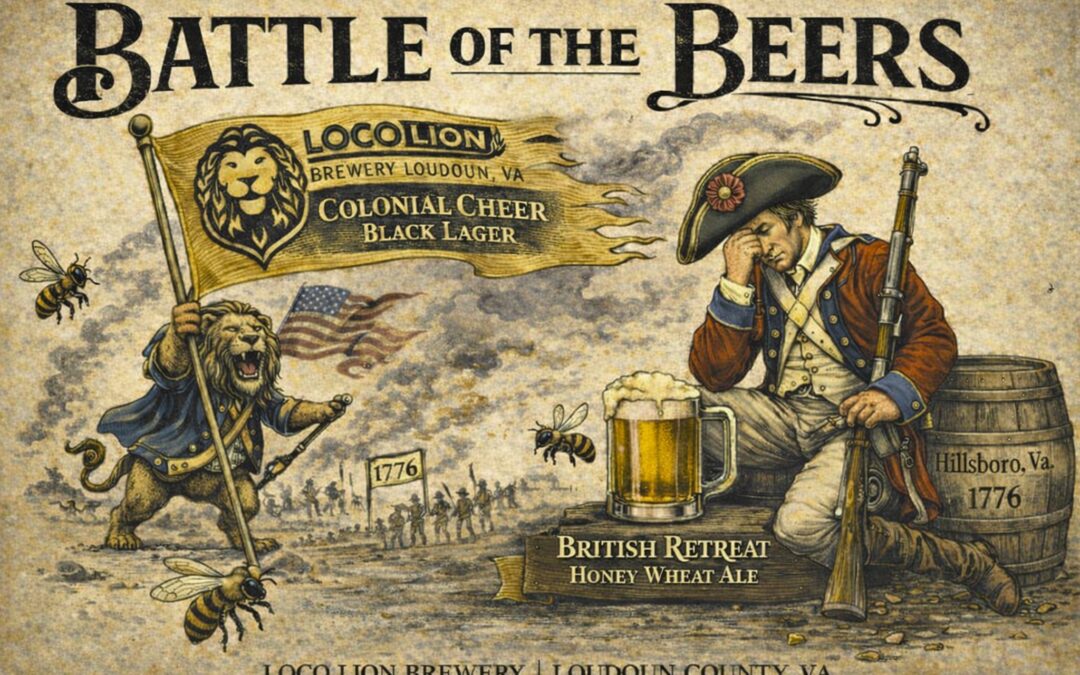
Loco Lion Brewing, in Hillsboro (Loudoun County), commemorated 1776 over Memorial Day weekend with a Battle of the Beers “contest.” Loco Lion released two historic liquids: Colonial Cheer Black Lager and British Retreat Honey Wheat Ale.
The brewery describes its Colonial Cheers as offering “the rare chance to taste a piece of Virginia’s liquid history; it bridges the gap between 18th-century ingenuity and the modern
craft excellence. We’ve enriched this brew with authentic molasses – an affordable sweetener made it a cornerstone of the 18th century colonial economy and a key ingredient in George Washington’s recipe for small beer.”
For its British Retreat, the brewery notes honey bees were transported to America in the 17th century and that local golden honey was included in this recipe.
Over at Virginia Beer Company (VBC), a partnership with a local media group has resulted in Strictly Business Hazy IPA.
“VBC has rebranded our Gorgeous Citra IPA in a limited edition can celebrating VA250,” said co-founder Robby Willey. “As our beautiful community gathers to celebrate America’s 250th, we thought it fitting to remind our neighbors that you are what you drink. We loved the idea of commemorating 250 years by celebrating ‘The Sound of America’s Hometown.’”
Cape Charles Brewing Company has produced American Lager, a “crisp and smooth lager built for star-spangled celebrations.”
The folks at One Family Brewing Co. have launched Freedom 250, a 4.5% ABV American lager “defined by its balance and freedom.” The can label features an eagle with Old Glory in the background.
Throughout the months of June and July be on the lookout for VA250-themed commemorative beer releases as they make their way to your favorite taprooms.
Check out the Virginia Craft Brewers Guild website to plot a roadtrip along the Revolutionary Brews Beer Trail.
A revolution is brewing. Drink up!